
Mu Shang Aluminum-Free Herbal Deodorant
What Causes Body Odour?
 Body odour is an
embarrassing problem for millions of people in our society. Afflicted individuals can suffer from lowered self-esteem and social withdrawal which impact both their personal and professional lives. How big is this problem? According to MarketResearch.Com, Americans spent an astonishing $1.9 billion on antiperspirants and deodorants in 2005 alone.
Body odour is an
embarrassing problem for millions of people in our society. Afflicted individuals can suffer from lowered self-esteem and social withdrawal which impact both their personal and professional lives. How big is this problem? According to MarketResearch.Com, Americans spent an astonishing $1.9 billion on antiperspirants and deodorants in 2005 alone.
Considerable research has been conducted on the causes of body odour, and this research has concluded that in generally healthy individuals, contrary to popular belief, the sweat itself does not smell. The smell we associate with sweat is actually caused by bacteria living in the sweaty areas of our bodies. When we sweat, the moist conditions provide an ideal environment for bacteria to multiply, and the oils in our sweat provide nutrients upon which the bacteria can feed. Therefore, there are three ways to reduce body odour: reduce the sweat, clean off the bacteria, or cover it up with a strong masking scent.
How do Conventional Deodorants Work?
Most of the popular deodorants are actually combined deodorant/antiperspirant products. The deodorant component is simply a perfume which is intended to mask the scent of body odour, and the antiperspirant component is an aluminum-based chemical compound. Most of the major brand-name products use aluminum zirconium tricholorohydrex glycine, but other aluminum salts such as aluminum chlorohydrate can be used as well. When we apply the antiperspirant to the underarm area, these aluminum-based compounds are absorbed into the body, specifically the skin cells and sweat glands. This causes those cells to swell up, thus plugging your sweat glands and preventing sweat from coming out. Some of the larger aluminum-based compounds are not easily absorbed by the skin, so they simply lodge themselves in our sweat glands and plug them.
While all the well-known brands claim to have "long-lasting" or "all day" effects, real users report considerably less effectiveness. The products tend to leave noticeable residue on the skin, the perfumed smell wears off quickly, and despite what the television advertisements may say about being "dry all day", users can easily find themselves sweating well before the end of the day.
Not everyone is comfortable with the idea of aluminum-based antiperspirants. There are even some reports [2] which suggest a link between aluminum-based deodorants and breast cancer, although this link has not been substantiated with epidemiological studies. There is also a well-known association between aluminum and Alzheimer's disease [3], which has led to recommendations that people apply aluminum-based deodorants only to clean, unbroken, non-irritated skin so that it cannot enter the bloodstream. There was also a well-documented case of a woman developing hyperaluminemia (causing bone pain and extreme fatigue) which was linked to her daily use of an aluminum-based antiperspirant [5].
What about Natural Deodorants?
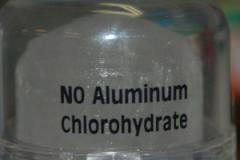
Concerns about aluminum-based deodorants have led to a number of so-called "natural deodorants". However, despite what we might think, the word "natural" does not necessarily mean that a product is aluminum-free. After all, aluminum does occur in nature, and if we read their labels carefully, we will find that a lot of these products don't actually say they are aluminum-free. Instead, they say they "contain no aluminum chlorohydrate", even though they may contain other kinds of aluminum such as aluminum sulfate (often referred to as "alum"). Anyone who wishes to avoid aluminum would probably not be happy with aluminum sulfate! Yet that is exactly what is contained in many "natural deodorants" which advertise that they "contain no aluminum chlorohydrate" and then list "alum" or "natural mineral salts" on their packaging.
Another increasingly popular natural deodorant is the "deodorant stone": a mineral stone which is rubbed against the affected areas of the body and which has an antiperspirant effect. What would you think if you learned that these stones work just like all of the other antiperspirants, by rubbing off aluminum sulfate onto the skin? Don't be surprised, because they are based on natural aluminum-bearing minerals such as kalinite. There are many terms that marketers can use in order to carefully describe an aluminum-based product without using the word "aluminum".
 |
 |
 |
 |
Genuine Aluminum-Free Deodorants
There are genuine aluminum-free deodorants available on the market, but you must be careful. As the ancient saying goes, caveat emptor: buyer beware. The fact that they don't use the word "aluminum" on their ingredient label does not mean they are aluminum-free. Watch out for terms like "mineral salts", "alum", or "kalinite". Also, some of them are genuinely aluminum-free but they simply use zirconium instead of aluminum. While zirconium is not presently considered a toxic substance, more study is warranted [4], and not everyone will be comfortable with the use of this metal.
The best way to know that we are getting an aluminum-free deodorant is to make sure that it does not have any antiperspirant effect. Antiperspirants work by plugging your sweat glands, and there are not very many ways to do this that do not involve metallic salts in some way. It may even be undesirable to prevent sweat, since it is a natural and healthy function of the human body after all.
Mu Shang Aluminum-Free Herbal Deodorant
Mu Shang Aluminum-Free Herbal Deodorant is a genuine aluminum-free deodorant. It contains no aluminum salts of any kind, and relies entirely on a combination of natural acids and herbs.
 About the ingredients:
- Acetic acid has been used for thousands of years in the form of vinegar. Vinegar is simply low-concentration acetic acid, and in addition to being a food condiment, vinegar is also popular as a mild and completely safe cleaning agent because of its well-known anti-bacterial and anti-fungal properties. Of course, vinegar has a well-known characteristic smell, which you will probably recognize when you apply the deodorant, but that fades away fairly quickly.
- Citric acid is found in all citrus fruits, such as oranges, grapefruits, and lemons. Like acetic acid, citric acid has well-known anti-bacterial properties, and it is also a well-known anti-oxidant.
- Curcuma is the root of the plant commonly known as Turmeric, which is a very well-known herb in both traditional medicine and cooking. It is a relative of ginger, it grows in the tropical regions of Southern Asia, and is believed to have healing properties.
- Peppermint has been called "the world's oldest medicine" and is one of the world's most ancient and popular flavouring agents. Due to its immense popularity as a food additive and "minty" fragrance, most people are unaware that peppermint also has anti-bacterial properties [1], associated with its high menthol content.
- Honeysuckle is a flowering plant which is often made into a tea. The flowers are fragrant, with a yellow-white colour. The tea is popular in China where it is believed to have cleansing properties.
Mu Shang Aluminum-Free Herbal Deodorant is a gentle yet effective formula, designed for people who want a true aluminum-free herbal deodorant which does not rely on adding artificial perfumes to your body. It has a mild "vinegar" aroma, which fades quickly after application. Unlike most deodorants which are used in the morning, it is applied at bedtime, so that it can work on your skin overnight. Mu Shang Aluminum-Free Herbal Deodorant is designed only for direct application to the skin, and must not be ingested. While Mu Shang Aluminum-Free Herbal Deodorant does not contain any strong perfumes, some people are extremely sensitive to fragrants of any kind (including natural herbal fragrants such as peppermint) and might theoretically experience a mild rash. Mu Shang Aluminum-Free Herbal Deodorant comes in a conveniently portable 50 mL (1.7 fl. oz) roll-on bottle.
References
- Antimicrobial screening of Mentha piperita essential oils, Iscan G, Kirimer N, Kurkcuoglu M, Baser KH, Demirci F., Journal of Agricultural and Food Chemistry, 2002 Jul 3;50(14):3943-6. Abstract.
- Aluminium, antiperspirants and breast cancer, Darbre PD., Journal of Inorganic Biochemistry, 2005 Sep;99(9):1912-9. Abstract.
- Aluminum and Alzheimer's disease, a personal perspective after 25 years, Perl DP, Moalem S., Mount Sinai School of Medicine, Journal of Alzheimer's Disease, 2006;9(3 Suppl):291-300. Abstract.
- Zirconium. An abnormal trace element in biology, Ghosh S, Sharma A, Talukder G, Biological Trace Element Research, 1992 Dec;35(3):247-71. Abstract.
- Hyperaluminemia in a Woman Using an Aluminum-Containing Antiperspirant for 4 Years, Guillard O, Fauconneau B, Olichon D, Dedieu G, Deloncle R., Department of Toxicology, University Hospital, Poitiers, France, American Journal of Medicine, 2004 Dec 15;117(12):956-9. Article can be purchased here.
